Journal of Occupational
Health and Epidemiology

Rafsanjan university Of medical sciences
Volume 15, Issue 2 (Spring 2026)
J Occup Health Epidemiol 2026, 15(2): 136-143 |
Back to browse issues page




Download citation:
BibTeX | RIS | EndNote | Medlars | ProCite | Reference Manager | RefWorks
Send citation to:


BibTeX | RIS | EndNote | Medlars | ProCite | Reference Manager | RefWorks
Send citation to:
Nezhadbagheripoor M, Kaabomeir N, Javedanipour Z, Farazestanian B. The Effect of Cognitive-Behavioral Stress-Management Training on Employees’ Psychological Well-Being, Self-Efficacy, Job Stress, and Intolerance of Uncertainty. , J Occup Health Epidemiol. 2026; 15 (2) :136-143
URL: http://johe.rums.ac.ir/article-1-1146-en.html
URL: http://johe.rums.ac.ir/article-1-1146-en.html
Related article in
Google Scholar
Google Scholar
Similar articles


1- M.Sc. in General Psychology, Dept. of Psychology, Faculty of Humanities, Khayyam University, Mashhad, Iran.
2- Assistant Prof., Dept. of Psychology, Binaloud Institution of Higher Education, Mashhad, Iran. ,n.kaabomeir@binaloud.ac.ir
3- Ph.D. Student in Specialized Psychology, Dept. of Psychology, Islamic Azad University, Neyshabur, Iran.
2- Assistant Prof., Dept. of Psychology, Binaloud Institution of Higher Education, Mashhad, Iran. ,
3- Ph.D. Student in Specialized Psychology, Dept. of Psychology, Islamic Azad University, Neyshabur, Iran.
Article history

Received: 2025/12/10
Accepted: 2026/04/17
ePublished: 2026/06/30
Accepted: 2026/04/17
ePublished: 2026/06/30
Subject:
Occupational Health
Keywords: Occupational Stress [MeSH], Cognitive Behavioral Therapy [MeSH], Self-Efficacy [MeSH], Psychological Well-Being [MeSH], Uncertainty [MeSH]
Full-Text [PDF 422 kb]
(103 Downloads)
| Abstract (HTML) (278 Views)
Table 3. Multilevel Linear Model results for the effect of intervention and time on outcome variables
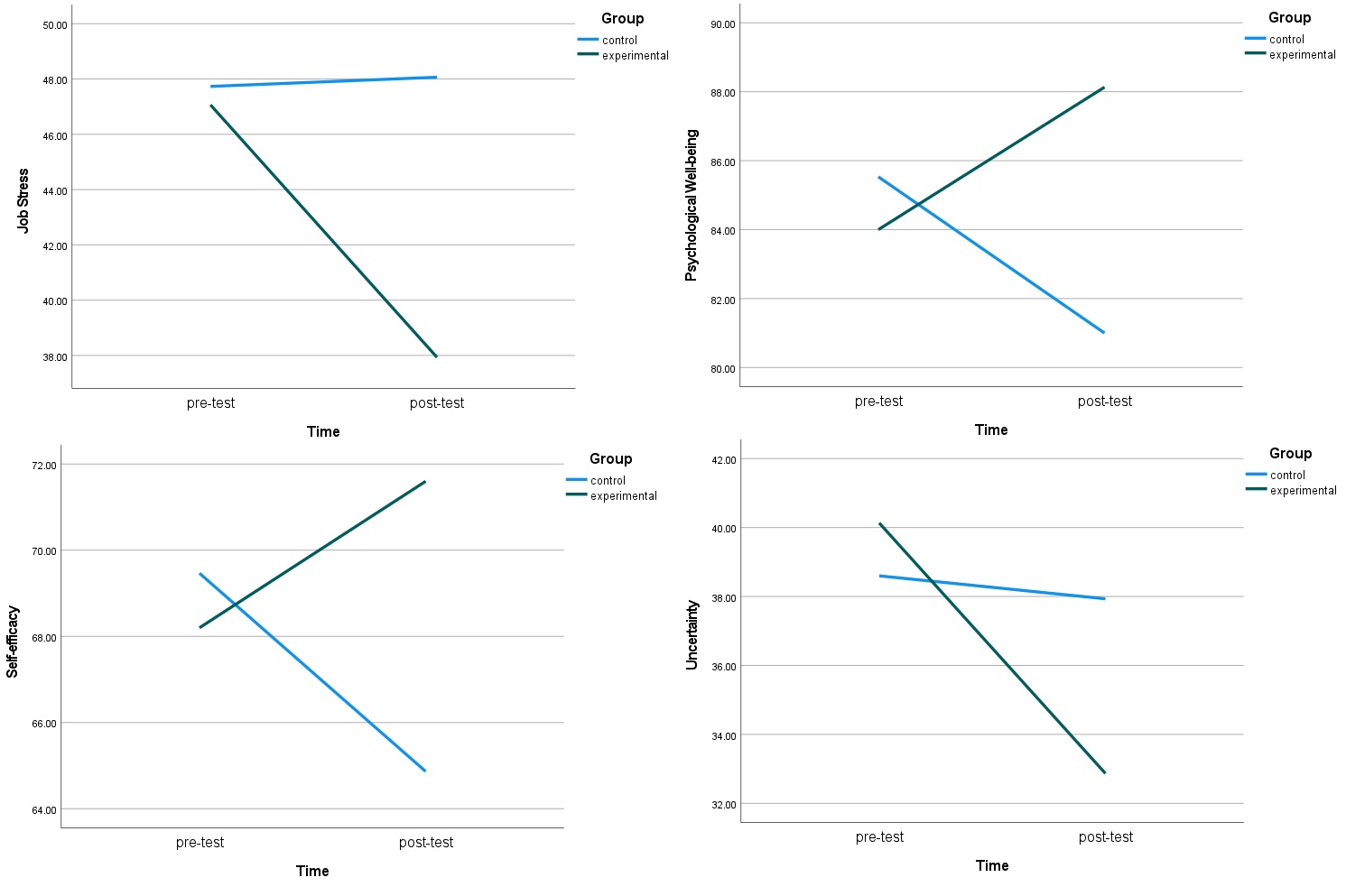
Fig. 1. Employees’ job stress (First image), psychological well-being (Second image), self-efficacy (Third image), and uncertainty (Fourth image) broken down by the experimental condition and time of the assessment
Full-Text: (6 Views)
Introduction
Over recent decades, stress has become a major factor affecting individuals’ physical and mental health. Indeed, it is recognized as a leading global contributor to diminished functioning and productivity [1]. Work-related stress is one of the most prevalent sources of psychological strain among employees and can negatively impact occupational performance, interpersonal relationships, and overall quality of life [2]. Job stress typically takes place when the demands of a role exceed an individual’s perceived coping resources or abilities [3]. Under such conditions, prolonged exposure to occupational stress can impair cognitive processes such as decision-making, diminish self-efficacy, and undermine psychological well-being [4]. Evidence suggests that structured stress-reduction programs can strengthen coping resources and boost employees’ perceived ability to manage demanding work environments [5].
Since prolonged job stress affects multiple psychological domains, researchers increasingly explore its relationship with broader indicators of mental functioning such as psychological well-being. Psychological well-being is a multidimensional construct encompassing emotional, psychological, as well as social aspects of positive functioning and reflects individuals’ evaluations of life satisfaction, personal growth, and meaningful engagement in daily activities [6]. Employees with higher levels of psychological well-being tend to exhibit greater work engagement, resilience, and more constructive workplace relationships [7]. Conversely, persistent job stress can erode well-being through promoting negative emotions, reducing motivation, and impairing work performance [8]. Environmental and occupational factors such as level of , organizational support, job demands, and workplace climate also influence employees’ psychological well-being [9].
Another psychological factor that may be affected by stressful work environments is intolerance of uncertainty (IU). IU refers to a dispositional cognitive bias in which individuals perceive uncertain or ambiguous situations as threatening and difficult to tolerate [10], Those with high IU tend to respond to uncertain circumstances with heightened worry, avoidance behaviors, and maladaptive coping strategies [11]. Empirical studies indicate that stressful environments can intensify intolerance of uncertainty, thereby heightening anxiety as well as reducing psychological adjustment and well-being [12]. Across organizational contexts characterized by rapid technological changes and unpredictable service demands—such as the telecommunications sector—employees frequently encounter uncertain situations, making IU particularly relevant to occupational stress research. Studies suggest that interventions aimed at stress management and cognitive restructuring can help individuals endure uncertainty more effectively and adopt adaptive coping strategies [10].
Self-efficacy is another key psychological construct closely linked to stress and coping processes. It refers to individuals’ beliefs about their capacity to organize and execute the actions required to achieve desired performance outcomes [13]. According to social cognitive theory, higher self-efficacy enables individuals to approach challenging tasks with greater confidence, persistence, and problem‑solving ability [14]. Across occupational settings, employees with strong self-efficacy are better able to regulate stress responses, maintain motivation under pressure, and adapt to demanding job conditions [15]. Conversely, high levels of job stress may undermine employees’ perceived competence and lower their confidence in handling work-related challenges.
Employees working in telecommunication service centers and customer-support units often operate in high-demand environments characterized by time pressure, continuous customer interaction, performance monitoring, as well as rapidly changing technological requirements. These conditions can expose employees to heightened levels of job stress and emotional strain, which in turn may affect their psychological well-being, tolerance for uncertainty, and perceived self-efficacy [14] .
Beyond its direct association with adverse psychological and physical outcomes, job stress may also play a key mediating role in the effectiveness of stress management interventions. Stress management programs primarily aim to modify individuals’ cognitive appraisals of work demands and boost coping skills, leading to diminished perceived job stress. Lowered job stress has been consistently linked to improvements in psychological well‑being, greater self‑efficacy, and more adaptive emotional as well as cognitive functioning, while also reducing vulnerability to negative outcomes such as depression, sleep disturbances, and physiological dysregulation [16]. Accordingly, examining job stress as a mediating variable provides a more precise understanding of how stress‑management interventions impact multiple psychological outcomes simultaneously.
Various approaches have been proposed to alleviate work‑related stress among employees. These include organizational interventions (e.g., job redesign and workload modification), individual‑focused interventions (e.g., relaxation training and mindfulness‑based programs), and cognitive‑behavioral stress management interventions [17]. Among these, cognitive‑behavioral stress management programs have received strong empirical support thanks to their structured focus on modifying maladaptive cognitions, strengthening coping skills, and promoting emotional regulation in stressful work environments [18].
Cognitive-behavioral stress management interventions commonly include core components such as cognitive restructuring, relaxation training, problem-solving skills, emotional regulation, and coping-skills training, which together help employees modify maladaptive thought patterns and ameliorate adaptive responses to workplace stressors. Recent studies have noted that cognitive-behavioral stress management interventions can effectively mitigate occupational stress while improving psychological well-being and self-efficacy among employees. For instance, cognitive-behavioral occupational stress management programs have been associated with diminished stress reactivity, lower exhaustion, and enhanced stress-management skills among employees working in demanding occupational settings [19]. Further, web-based and mobile stress-management interventions grounded in cognitive-behavioral principles have demonstrated positive effects on perceived stress reduction, emotional adjustment, and occupational well-being among workers [14, 16].
Accordingly, the present study aimed to explore the effectiveness of cognitive behavioral stress management training on employees’ psychological well-being, intolerance of uncertainty, and self-efficacy, with job stress inspected as a potential mediator of these effects.
Materials and Methods
In terms of its objective, this study was applied research, with a quasi-experimental design involving a pre-test and post-test structure whereby a control group was employed. The statistical population consisted of all employees of the Irancell Call-Center unit in Mashhad in 2023, totaling 150 employees (117 men and 33 women). From this population, 30 employees who fulfilled the eligibility criteria were recruited for the study.
The inclusion criteria were: (1) obtaining a score above 40 on the Girdano Job Stress Questionnaire [20]; (2) age between 30 and 50 years; (3) having basic literacy skills sufficient for participating in the training sessions and completing the study instruments; and (4) providing informed consent to participate in the research. The exclusion criteria were: (1) presence of a severe psychiatric disorder based on self-report or clinical referral; (2) receiving any psychiatric or psychological treatment over the previous six months; (3) having previously received training in life skills or stress management; and (4) a history of drug abuse or alcohol dependence.
Following the assessment of eligibility criteria, the participants were randomly assigned to the intervention and control groups, with 15 participants in each group. Simple randomization was employed for group allocation. For this purpose, a pre-prepared table of random numbers was utilized. Each participant was assigned a numerical code, and participants were allocated to one of the two groups according to the parity of the corresponding random number. Even numbers were assigned to the intervention group, while odd numbers were assigned to the control group.
The study employed a single-blind design. The participants were not informed of the primary objective of the study, the hypotheses under investigation, or their specific group assignment. All participants received general information regarding the study procedures, while the specific nature of the experimental intervention was not disclosed until completion of data collection. Both groups completed the study instruments at pre-test and post-test. The intervention group received cognitive behavioral stress management training, whereas the control group did not receive the intervention along the study period.
Job Stress Questionnaire, developed by Girdano, Everly, & Dusek, in 1990 [20], is a 14-item scale appraising job stress across four dimensions: work pace, competitiveness, overexertion, and unplanned work. Items are rated on a 5-point Likert scale (1 = strongly disagree to 5 = strongly agree), with total scores ranging from 14 to 70; higher scores reflect greater stress. The original version reported a Cronbach’s alpha of 0.90. The Persian version, employed in the study [21], exhibited a Cronbach’s alpha of 0.93. Content validity was also established in the Persian adaptation.
Psychological Well-Being Scale – Short Form [22].
The Psychological Well-Being Scale – Short Form (PWB-SF) was developed by Ryff in 1989 to ascertain six dimensions of psychological well-being: self-acceptance, environmental mastery, positive relations with others, purpose in life, personal growth, and autonomy. Each dimension includes three items, rated on a 6-point Likert scale ranging from 1 (strongly disagree) to 6 (strongly agree). Thus, subscale scores range from 3 to 18, with the total score ranging within 18 to 108. In the original version, Cronbach’s alpha for the subscales ranged from 0.33 to 0.56, reflecting the limited number of items per dimension. The Persian version of the PWB-SF was validated [23]. The overall reliability of the Persian version was excellent (Cronbach’s alpha = 0.924), with exploratory factor analysis supporting the six-factor structure of the original scale.
Self-Efficacy Scale was developed by Sherer et al. in 1982 [24]. The original version consisted of 36 items; the version utilized in this study comprises 23 items. Each item is rated on a 5-point Likert scale (1 = strongly disagree, 5 = strongly agree), leading to a total score range of 23–115, where higher scores demonstrate greater self-efficacy. Total scores can be interpreted as low self-efficacy (23–53), moderate self-efficacy (54–84), and high self-efficacy (85–115). Reliability and validity of the original version were reported as Cronbach’s alpha = 0.79 and convergent validity, with correlations of r = 0.20–0.30 (p < 0.05) between the scale and the Rosenberg Self-Esteem Scale (p < 0.05). In the Persian version [25], Cronbach’s alpha was 0.82, indicating good internal consistency, and it also showed convergent validity with related constructs.
Intolerance of Uncertainty Scale – Short Form (IUS-12) was developed by Freeston, Rhéaume, Letarte, Dugas, and Ladouceur in 1994 [26] to appraise four components of intolerance of uncertainty: inability to act, stressfulness, negativity, avoidance, and future-oriented uncertainty. The short form consists of 12 items, each rated on a 5-point Likert scale (1 = never, 5 = always), yielding a total score range from 12 to 60. The original version demonstrated strong reliability, with Cronbach’s alpha = 0.91 and test–retest reliability = 0.78. The Persian version [27] presented a Cronbach’s alpha of 0.89, and its content as well as construct validity were confirmed.
The experimental group underwent a series of stress management skills training sessions, spanning an eight-week period from May 2023 to July 2023. These instructional sessions were implemented weekly, each lasting 90 minutes, in a group setting. To facilitate skill consolidation and transfer to the workplace, the participants were assigned homework exercises following each session. The training program was underpinned by a cognitive-behavioral framework [27]. A detailed breakdown of the curriculum is reported in Table 1.
Table 1. Content of Stress Management Training Sessions
| Session | Main Topics | Key Activities and Assignments | |
| 1 | Program introduction, stress education, and progressive muscle relaxation. | Stress monitoring and relaxation practice | |
| 2 | Thoughts–emotions relationship and negative thinking patterns | Stress recording and relaxation exercises | |
| 3 | Breathing techniques, guided imagery, and cognitive restructuring | Practice of breathing and imagery. | |
| 4 | Cognitive distortions and integration of relaxation techniques | Identification of negative thoughts | |
| 5 | Autogenic training and self‑talk modification. | Autogenic practice and thought replacement | |
| 6 | Stress responses and coping strategies. | Coping review and continued practice | |
| 7 | Adaptive coping and positive self‑statements | Integrated relaxation and coping practice | |
| 8 | Program review and post-test. | Completion of exercises and post-test | |
The intervention effects were analyzed using a multilevel regression approach based on the difference-in-differences (DiD) framework. Given the pre- and post-test control group design, repeated observations were treated as nested within participants, with the intervention effect estimated through the Time × Group interaction term. This interaction captured the differential change over time between the experimental and control groups and was interpreted as the causal effect of the intervention. Further, the mediating effect of job stress on the association between the intervention and dependent variables was explored by estimating the indirect pathway using pre-test to post-test changes. Analyses were undertaken in SPSS-27 and statistical significance was determined at p < .05.
Results
The study sample comprised 30 employees, randomly assigned to the experimental (n=15) and control (n=15) groups. In the experimental group, the majority were men (73.3%), with 4 women (26.7%). The control group also consisted predominantly of men (80.0%), with 3 women (20.0%). The mean age of participants was 34.73 ± 4.40 years in the experimental group and 34.60 ± 1.92 years in the control group. The corresponding mean of employees’ tenure was 10.53 ± 4.76 years and 10.46 ± 2.99 years, respectively. To preliminarily examine the study variables, the means and standard deviations were computed at both assessment phases. Also, paired-samples t-tests were conducted separately for each group. The results are outlined in Table 2.
Table 2. Means and standard deviations of study variables across groups and time points
| Variable | Group | Time 1 (M ± SD) |
Time 2 (M ± SD) |
T | df | p | Mean Difference [95% CI] |
| Job Stress | Control | 47.73 ± 5.34 | 48.07 ± 6.44 | -.31 | 14 | .76 | -.33 [-2.60; 1.94] |
| Experimental | 47.07 ± 6.34 | 37.93 ± 6.46 | 13.52 | 14 | .00 | 9.13 [7.68; 10.58] | |
| Well-Being | Control | 85.53 ± 7.51 | 81.00 ± 9.30 | 1.36 | 14 | .20 | 4.53 [-2.63; 11.70] |
| Experimental | 84.00 ± 8.41 | 88.13 ± 7.81 | -6.32 | 14 | .00 | -4.13 [-5.53; -2.73] | |
| Self-Efficacy | Control | 69.47 ± 7.49 | 64.87 ± 8.43 | 1.60 | 14 | .13 | 4.60 [-1.59; 10.79] |
| Experimental | 68.20 ± 9.31 | 71.60 ± 8.40 | -3.62 | 14 | .03 | -3.40 [-5.42; -1.38] | |
| Uncertainty | Control | 38.60 ± 7.78 | 37.93 ± 5.96 | .34 | 14 | .74 | .67 [-3.53; 4.87] |
| Experimental | 40.13 ± 6.86 | 32.87 ± 7.24 | 14.47 | 14 | .00 | 7.27 [6.19; 8.34] |
Paired-sample t-tests indicated that the experimental group experienced significant reductions in job stress (p<0.00) and intolerance of uncertainty (p<0.00), along with increments in psychological well-being (p<0.00) and self-efficacy (p<0.03). The control group demonstrated no significant changes (See Table 2).
A series of multilevel linear models was conducted to
test the study hypotheses. In Step 1, age, tenure, time (coded 0 = pre-intervention and 1 = post-intervention), group (0 = control, 1 = experimental), and the Group × Time interaction were entered as predictors of the four outcome variables. In Step 2, job stress was included as a time-varying covariate to explore its potential mediating effect (Table 3).
Table 3. Multilevel Linear Model results for the effect of intervention and time on outcome variables
| Predictor | Job Stress | Well-Being | Self-Efficacy | Uncertainty |
| Step 1 | β (SE) | β (SE) | β (SE) | β (SE) |
| Age | 0.02 (0.27) | -0.10 (0.38) | -0.18 (0.39) | 0.01 (0.32) |
| Tenure | 0.25* (0.23) | 0.00 (0.33) | 0.02 (0.34) | -0.20 (0.29) |
| Group | 0.60 (4.85) | -0.54 (6.88) | -0.50 (7.14) | 0.52 (5.92) |
| Time | 0.67* (4.85) | -0.74 (6.88) | -0.70 (7.19) | 0.36 (5.97) |
| Group × Time | -1.41** (3.07) | 1.03* (4.35) | 0.94* (4.76) | -0.88 (3.95) |
| Step 2 | — | — | — | — |
| Job Stress | — | -1.09* (4.23) | -0.06 (0.19) | 0.07 (0.16) |
| R² | .40** | .22* | .12 | .17* |
*p < .05; **p < .01
As indicated in Table 3, the Group × Time interaction was significant for job stress (β = −1.41, p = .003), psychological well-being (β = 1.03, p = .045), and self-efficacy (β = 0.94, p = .049), reflecting greater improvement over time in the experimental group. Further, when job stress was included in the model, it significantly and negatively predicted psychological well-being (β = −1.09, p = .027), providing evidence of partial mediation. Bootstrapping further confirmed a significant indirect impact on psychological well-being (indirect = −0.14, 95% CI: −0.28 to −0.02).
Fig. 1 depicts the temporal changes in job stress, psychological well-being, self-efficacy, and uncertainty, differentiating between the experimental and control groups from pre-test to post-test.
Fig. 1 depicts the temporal changes in job stress, psychological well-being, self-efficacy, and uncertainty, differentiating between the experimental and control groups from pre-test to post-test.
Fig. 1. Employees’ job stress (First image), psychological well-being (Second image), self-efficacy (Third image), and uncertainty (Fourth image) broken down by the experimental condition and time of the assessment
Discussion
The results of this study demonstrated that stress management training significantly improves employees’ psychological well-being, self-efficacy, and tolerance of uncertainty. These findings align with previous research, highlighting the role of stress management interventions in enhancing psychological outcomes [14, 27–31]. The aim of such training is not to eliminate stress entirely but rather to help employees recognize its nature, manage it effectively, and adopt strategies to mitigate negative effects, thereby ameliorating workplace quality of life.
Stress management interventions can modify individuals’ responses to stressors and promote adaptive behavioral changes, facilitating better adjustment to stressful work environments [32]. The intervention group in this study exhibited improvements in life satisfaction, positive emotions, and overall well-being compared to the control group, in line with prior findings [8, 29]. Stress management training also strengthens emotion regulation skills, which further supports psychological well-being [6].
Self-efficacy, a key determinant of motivation and performance, is closely tied to stress management. Through providing coping strategies, stress management training lowers perceived stress and boosts individuals’ confidence in managing challenges, which in turn augments self-efficacy [28]. Those with higher self-efficacy experience less work-related stress, feel more in control, and are more likely to function effectively under pressure [33].
Intolerance of uncertainty, defined as difficulty tolerating ambiguous situations or lack of information, is another important factor influenced by stress management. Those with low tolerance for uncertainty often react impulsively, which provides only short-term relief and does not solve underlying problem [26]. Training that promotes problem-solving and positive coping mitigates intolerance of uncertainty by ameliorating employees’ ability to manage ambiguity [34, 35]
In this study, job stress played a mediating role between stress management training and psychological well-being. High levels of job stress can result in negative emotional, psychological, and physical outcomes, affecting both cognitive performance and job efficiency [18, 32]. Through addressing and managing stressors, employees can boost resilience, improve well-being, and maintain better social support networks [36]. The mediation analysis confirmed that reductions in job stress contributed to the intervention’s positive effects on well-being, supporting previous evidence that managing occupational stress is critical for improving mental health [34, 35].
Even though the intervention significantly improved psychological well-being, self-efficacy, and tolerance of uncertainty, some indirect mediation pathways were not statistically significant. One possible explanation is that workplace stress is impacted not only by individual coping abilities but also by organizational factors such as workload, emotional demands, and limited job control [37]. Research has indicated that many occupational stressors are beyond employees’ direct control and depend on organizational resources as well as management practices, which may compromise some indirect psychological pathways despite improvements in coping skills [37, 38].
Further, intolerance of uncertainty and self-efficacy may be affected by contextual and individual differences, causing some intervention effects to emerge more gradually. Previous studies suggest that indirect effects in models involving self-efficacy and occupational stress may vary depending on contextual and methodological factors, and are not always robust across different samples and settings [27, 39]. The relatively small sample size in the present study may have also lowered the statistical power required to detect weaker mediation effects, as noted in recent interventional research [40].
In spite of the contributions of the present study, several limitations should be considered when interpreting the findings. First, the study was conducted among employees working in customer service units within a specific organizational context, which may restrict the generalizability of the results to other occupational groups or organizational settings. Further, the data were collected using self-report questionnaires, which may be influenced by response bias or social desirability. Also, although the intervention exhibited beneficial effects, extended follow-up was not feasible because of organizational constraints and scheduling limitations within the workplace; thus, the long‑term sustainability of the intervention effects could not be examined. Eventually, organizational and cultural factors within the workplace environment may have influenced employees’ perceptions of stress and participation in the intervention.
Despite these promising results, further research is warranted. Future studies should inspect the long‑term sustainability of intervention effects through extended follow‑up assessments, test the program across more diverse occupational groups and organizational cultures, and incorporate multi‑method approaches beyond self-report measures. Exploration of additional mechanisms—such as emotion‑regulation skills, job resources, or team‑level factors—may also deepen understanding of how stress‑management interventions exert their effects. Such efforts can broaden the applicability of the present findings as well as support the development of more comprehensive workplace mental‑health programs.
Conclusion
The findings of this study highlight the value of structured stress‑management training for employees in high‑demand customer service roles within the telecommunications sector. The intervention not only mitigated job stress and improved psychological well‑being and self-efficacy, but also demonstrated that reductions in job stress partially explain improvements
in well‑being—a pathway that has received limited empirical attention in this occupational context. This novel evidence emphasizes the importance of targeting job stress as a key mechanism for enhancing employees’ mental health.
Acknowledgments
The authors thank all the people who participated in this research.
Conflict of interest
None declared.
Funding
The authors received no financial support for the research, authorship, and/or publication of this article.
Ethical Considerations
Written informed consent was obtained from all participants prior to their participation in the study and the study adhered to national ethical guidelines for research in Iran.
Code of Ethics
Ethical approval was obtained from the Khayyam University Research Ethics Committee (IR.KHAYYAM.REC.1404.003), and the study was registered with the Iranian Registry of Clinical Trials (IRCT) under registration number IRCT20260802070489N1.
Authors' Contributions
Mohadeseh Nezhadbagheripoor: Protocol conceptualization and design, delivery of the intervention, and contribution to manuscript structure; Noori Kaabomeir: Conceptualization and statistical analysis; Zahra Javedanipour: Manuscript drafting, writing, and editorial revisions; Bahareh Farazestanian: Participation in implementing the intervention; English translation.
References
1. HM Choi, Mohammad AAA, Kim WG. Understanding hotel frontline employees’ emotional intelligence, emotional labor, job stress, coping strategies and burnout. Int J Hosp Manag. 2019;82:199-208. [DOI]
2. Davies ACL. Stress at Work: Individuals or Structures?. Ind Law J. 2022;51(2):403-34. [DOI]
3. Terp U, Hjärthag F, Bisholt B. Effects of a Cognitive Behavioral-Based Stress Management Program on Stress Management Competency, Self-efficacy and Self-esteem Experienced by Nursing Students. Nurse Educ. 2019;44(1):E1-5. [DOI] [PMID]
4. Lucier‐Greer M, Frye‐Cox N, Reed‐Fitzke K, Ferraro AJ, Mancini JA. Military‐related stress, self‐efficacy, and anxiety: Investigating the role of marital quality in military couples. Fam Process. 2023;62(3):1253-71. [DOI] [PMID]
5. Rasool SF, Wang M, Zhang Y, Samma M. Sustainable work performance: the roles of workplace violence and occupational stress. Int J Environ Res Public Health. 2020;17(3):912. [DOI] [PMID] [PMCID]
6. Ryff CD. Psychological Well-Being Revisited: Advances in the Science and Practice of Eudaimonia. Psychother Psychosom. 2014;83(1):10-28. [DOI] [PMID] [PMCID]
7. Frost S, Kannis-Dymand L, Schaffer V, Millear P, Allen A, Stallman H, et al. Virtual immersion in nature and psychological well-being: A systematic literature review. J Environ Psychol. 2022;80:101765. [DOI]
8. Zadok-Gurman T, Jakobovich R, Dvash E, Zafrani K, Rolnik B, Ganz AB, et al. Effect of inquiry-based stress reduction (Ibsr) intervention on well-being, resilience and burnout of teachers during the covid-19 pandemic. Int J Environ Res Public Health. 2021;18(7):3689. [DOI] [PMID] [PMCID]
9. Siebecke DE, Jarl M. Does the material well-being at schools successfully compensate for socioeconomic disadvantages? Analysis of resilient schools in Sweden. Large Scale Assess Educ. 2022;10(1):11. [DOI]
10. Shu J, Ochsner KN, Phelps EA. Trait Intolerance of Uncertainty Is Associated with Decreased Reappraisal Capacity and Increased Suppression Tendency. Affect Sci. 2022;3(3):528-38. [DOI] [PMID] [PMCID]
11. Koerner N, Mejia T, Kusec A. What’s in a name? Intolerance of uncertainty, other uncertainty-relevant constructs, and their differential relations to worry and generalized anxiety disorder. Cogn Behav Ther. 2017;46(2):141-61. [DOI] [PMID]
12. Gorka SM, Nelson BD, Phan KL, Shankman SA. Intolerance of uncertainty and insula activation during uncertain reward. Cogn Affect Behav Neurosci. 2016;16(5):929-39. [DOI] [PMID]
13. Bandura A. Self-eficacy in chunging societies. New York, United States: Cambridge University Prees; 1997.
14. Egger SM, Frey S, Sauerzopf L, Meidert U. A Literature Review to Identify Effective Web- and App-Based mHealth Interventions for Stress Management at Work. Workplace Health Saf. 2023;71(10):452-63. [DOI] [PMID] [PMCID]
15. Jentsch A, Hoferichter F, Blömeke S, König J, Kaiser G. Investigating teachers’ job satisfaction, stress and working environment: The roles of self-efficacy and school leadership. Psychol Sch. 2023;60(3):679-90.
16. Farzadkia M, Farhangi A, Abolghasemi S. Comparing the effectiveness of mindfulness-based stress reduction and intensive short-term dynamic psychotherapy in reducing intolerance of uncertainty and depression in women with fibromyalgia. Women Health Bull. 2023;10(1):44-51. [DOI]
17. Kim MS, Kim K, Nam J, Lee SJ, Lee SW. Impact of Childhood Maltreatment on Cognitive Function and Its Relationship With Emotion Regulation in Young Adults. J Korean Acad Child Adolesc Psychiatry. 2024;35(3):155-62. [DOI] [PMID] [PMCID]
18. Salsabilla A, Setiawan M, Juwita HA. The effect of workload and job stress on job satisfaction mediated by work motivation. Int J Res Bus Soc Sci. 2022;11(9):97-106. [DOI]
19. Wirtz PH, Auer A, Semmer NK, Ehlert U, Nussbeck FW. Beneficial effects of a cognitive-behavioral occupational stress management group training: the mediating role of changing cognitions. Front. Psychol. 2024;14:1232172. [DOI] [PMID] [PMCID]
20. Howard AH, Roberts M, Mitchell T, Wilke NG. The Relationship Between Spirituality and Resilience and Well-being: a Study of 529 Care Leavers from 11 Nations. Advers Resil Sci. 2023;4(2):177-90. [DOI] [PMID] [PMCID]
21. Girdano DA, Everly Jr GS, Dusek DE. Controlling Stress and Tension, 3rd ed. Englewood Cliffs, New Jersey, United States: Prentice Hall; 1990.
22. Adibi Z, Ansari-Shahidi M, Rahnejat A, Rezaei-Jamalouei H. The Effectiveness of Mindfulness Based Cognitive Therapy on the Job Stress and Psychological Well-being in Personnel with Burnout in Isfahan Gas Company. J Nurs Physician War. 2020;8(27):70-8. [DOI]
23. Ryff CD. Happiness Is Everything, or Is It? Explorations on the Meaning of Psychological Well-Being. J Personal Soc Psychol. 1989;57(6):1069.
24. Kalantar SM, Navarbafi F. Reliability and Exploratory Factor Analysis of Psychological Well-being in a Persian Sample. Sci Ser Data Rep. 2012;4(1):11-27.
25. Sherer M, Maddux JE, Mercandante B, Prentice-Dunn S, Jacobs B, Rogers RW. The Self-Efficacy Scale: Construction and Validation. Psychol Rep. 1982;51(2):663-71. [DOI]
26. Rajabi M, Zargham Hajebi M, Monirpour N. Explanation of the Model of Marital Commitment Based on Object Relations with the Mediating Role of Emotion Regulation. J Assess Res Appl Couns. 2024;6(4):181-8. [DOI]
27. Freeston MH, Rhéaume J, Letarte H, Dugas MJ, Ladouceur R. Why do people worry?. Pers Individ Dif. 1994;17(6):791-802. [DOI]
28. Rashtbari A, Diba T, Nasiri Sharaf F, Zolghadriha A, Saed O. I just want to be certain’: psychometric properties and predictive role of the Intolerance of Uncertainty Scale-12. Shenakht J Psychol Psychiatry. 2022;9(5):101-14. [DOI]
29. Nixon P, Ebert DD, Boß L, Angerer P, Dragano N, Lehr D. The Efficacy of a Web-Based Stress Management Intervention for Employees Experiencing Adverse Working Conditions and Occupational Self-efficacy as a Mediator: Randomized Controlled Trial. J Med Internet Res. 2022;24(10):e40488. [DOI] [PMID] [PMCID]
30. Lee YJ. Effects of a mobile health intervention on activities of stress self-management for workers. Work. 2023;75(1):233-41. [DOI] [PMID]
31. Zetterberg H, Owiredua C, Åsenlöf P, Lennartsson R, Brodda Jansen G, Boersma K, et al. Preventing Pain and Stress-Related Ill-Health in Employees: A 6-Months Follow-Up of a Psychosocial Program in a Cluster Randomized Controlled Trial. J Occup Rehabil. 2023;33(2):316-28. [DOI] [PMID] [PMCID]
32. Andersson C, Mellner C, Lilliengren P, Einhorn S, Bergsten KL, Stenström E, et al. Cultivating Compassion and Reducing Stress and Mental Ill-Health in Employees—A Randomized Controlled Study. Front Psychol. 2022;12:748140. [DOI] [PMID] [PMCID]
33. Li Q, Du H, Chi P. Job stress and well-being among internal migrant workers in China: A review and meta-analysis. Appl Psychol Health Well Being. 2021;13(3):537-58. [DOI] [PMID]
34. Gajewski PD, Stahn C, Zülch J, Wascher E, Getzmann S, Falkenstein M. Effects of cognitive and stress management training in middle-aged and older industrial workers in different socioeconomic settings: a randomized controlled study. Front Psychol. 2023;14:1229503. [DOI] [PMID] [PMCID]
35. Ponting C, Chavira DA, Dunkel Schetter C, Urizar GG. Cognitive behavioral stress management effects on prenatal anxiety among low-income women. J Consult Clin Psychol. 2022;90(2):148-60. [DOI] [PMID] [PMCID]
36. Tör-Çabuk K, Koç V. Cognitive bias modification for perfectionism and intolerance of uncertainty: A randomized controlled trial. Psych J. 2024;13(4):679-91. [DOI] [PMID] [PMCID]
37. Alhasani M, Orji R. Correction to: SortOut: Persuasive Stress Management Mobile Application for Higher Education Students. In: Baghaei N, Vassileva J, Ali R, Oyibo K. (eds). Persuasive Technology. Persuasive 2022. Lecture Notes in Computer Science, vol 13213. Cham: Springer; 2022. [DOI]
38. Hsieh CM, Tsai BK. Effects of Social Support on the Stress-Health Relationship: Gender Comparison among Military Personnel. Int J Environ Res Public Health. 2019;16(8):1317. [DOI] [PMID] [PMCID]
39. Shao L, Guo H, Yue X, Zhang Z. Psychological Contract, Self-Efficacy, Job Stress, and Turnover Intention: A View of Job Demand-Control-Support Model. Front Psychol. 2022;13:868692. [DOI] [PMID] [PMCID]
40. Arvidsson L, Skytt B, Lindberg M, Lindberg M. Nurses' assessed self-efficacy levels to medical asepsis and their relation to structural empowerment, work engagement and work-related stress. Work. 2023;74(2):501-13. [DOI] [PMID] [PMCID]
Send email to the article author
| Rights and permissions | |
 |
This work is licensed under a Creative Commons Attribution 4.0 International License. |